Indications for Lifshitz transitions in the nodal-line semimetal ZrSiTe induced by interlayer interaction
This work marks my first contribution to a real scientific project. It was based on high-pressure measurements carried out by my colleagues on the layered material ZrSiTe. Through Raman spectroscopy and x-ray diffraction experiments, they obtained valuable insights into the structure and lattice dynamics of the material. I contributed theoretical analysis based on electronic structure calculations using WIEN2k. We were able to demonstrate that features observed in the pressure-dependent experimental data correlate with changes in the electronic band structure, in particular with bands crossing the Fermi level causing massive changes in the morphology of the Fermi surface.
For this project I was supervised by Georg Eickerling, who introduced me to the fundamentals of density functional theory (DFT) for periodic systems. As a chemist trained to think in terms of molecules, it was initially quite challenging to adopt the — at first glance counterintuitive — perspective required for periodic systems. Starting with very limited prior experience working in a Linux environment, I quickly became proficient in using the bash shell. This experience sparked a lasting enthusiasm for Linux-based systems, which I would not want to miss anymore. I also learned the basics of programming using Python, which I used to write some simple tools that help with running and post-processing the electronic structure calculations.
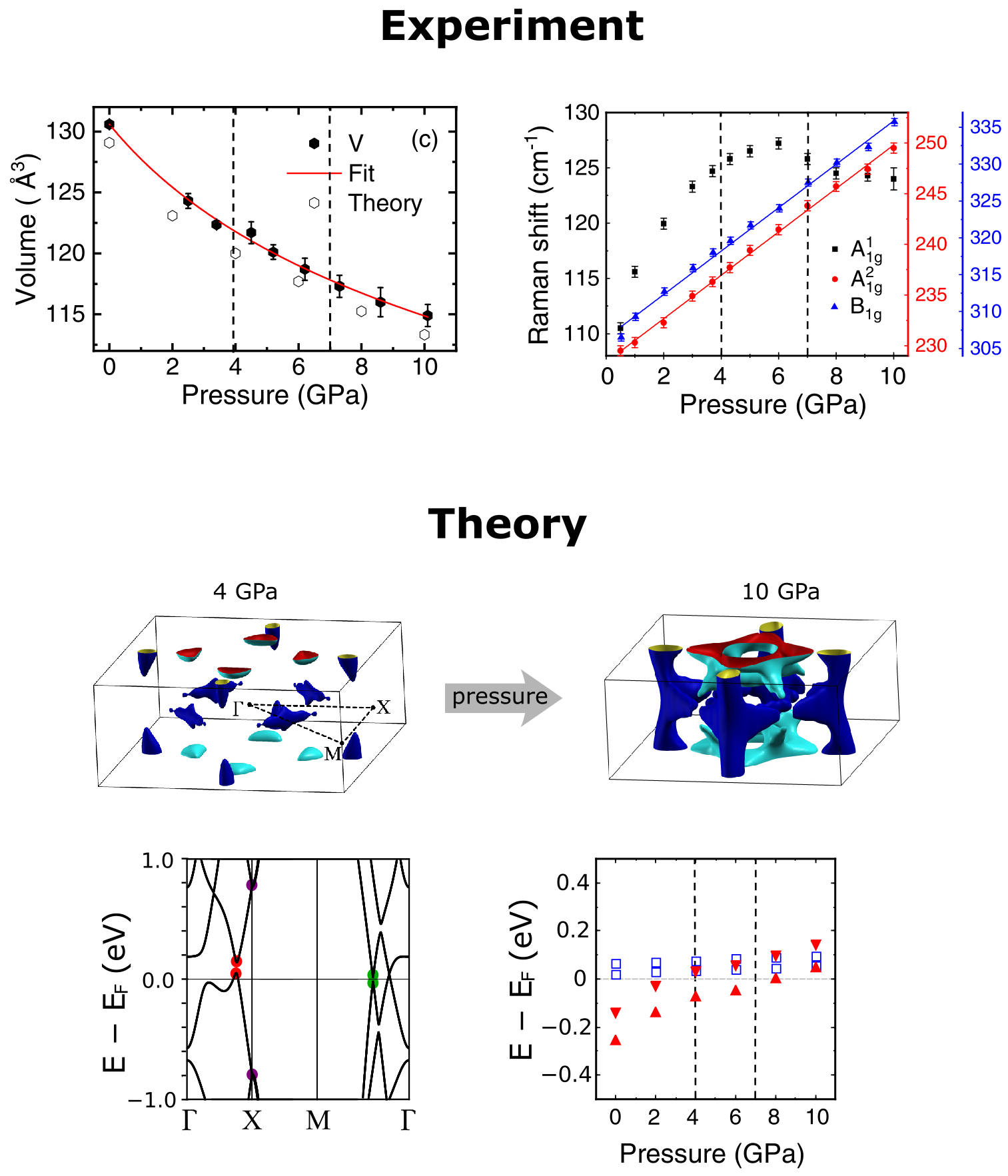
Krottenmüller, M.; Vöst, M.; Unglert, N.; Ebad-Allah, J.; Eickerling, G.; Volkmer, D.; Hu, J.; Zhu, Y. L.; Mao, Z. Q.; Scherer, W.; Kuntscher, C. A. Indications for Lifshitz Transitions in the Nodal-Line Semimetal ZrSiTe Induced by Interlayer Interaction. Phys. Rev. B 2020, 101 (8), 081108. https://doi.org/10.1103/PhysRevB.101.081108.